
Author: Editorial Board – Hami Law House
Introduction
The Constitution of India is the supreme law of the country and forms the foundation of India’s democratic system. It establishes the framework of governance, defines the powers and responsibilities of various organs of the Government, guarantees Fundamental Rights to citizens, and ensures justice, liberty, equality, and fraternity.
Adopted on 26 November 1949 and effective from 26 January 1950, the Constitution reflects the collective vision of the people of India for a sovereign, democratic, and inclusive nation.
Whether you are a citizen seeking legal awareness, a law student preparing for examinations, or a legal professional looking for a concise reference, understanding the Constitution is essential.
In this guide, Hami Law House explains the Constitution of India in simple and easy-to-understand language.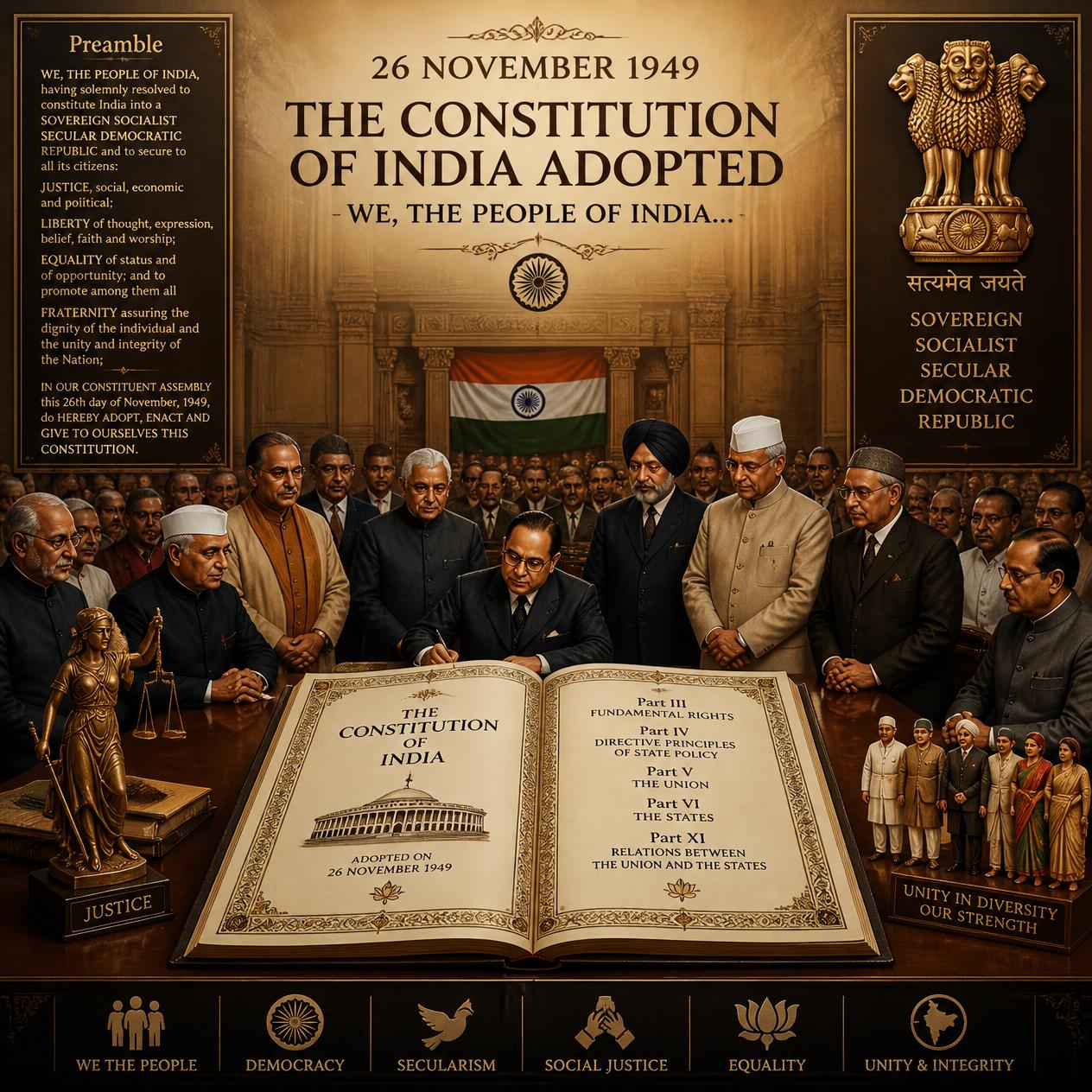
Table of Contents
- What is the Constitution of India?
- Why is the Constitution Important?
- History of the Constitution
- Constitution Making Process
- Constituent Assembly
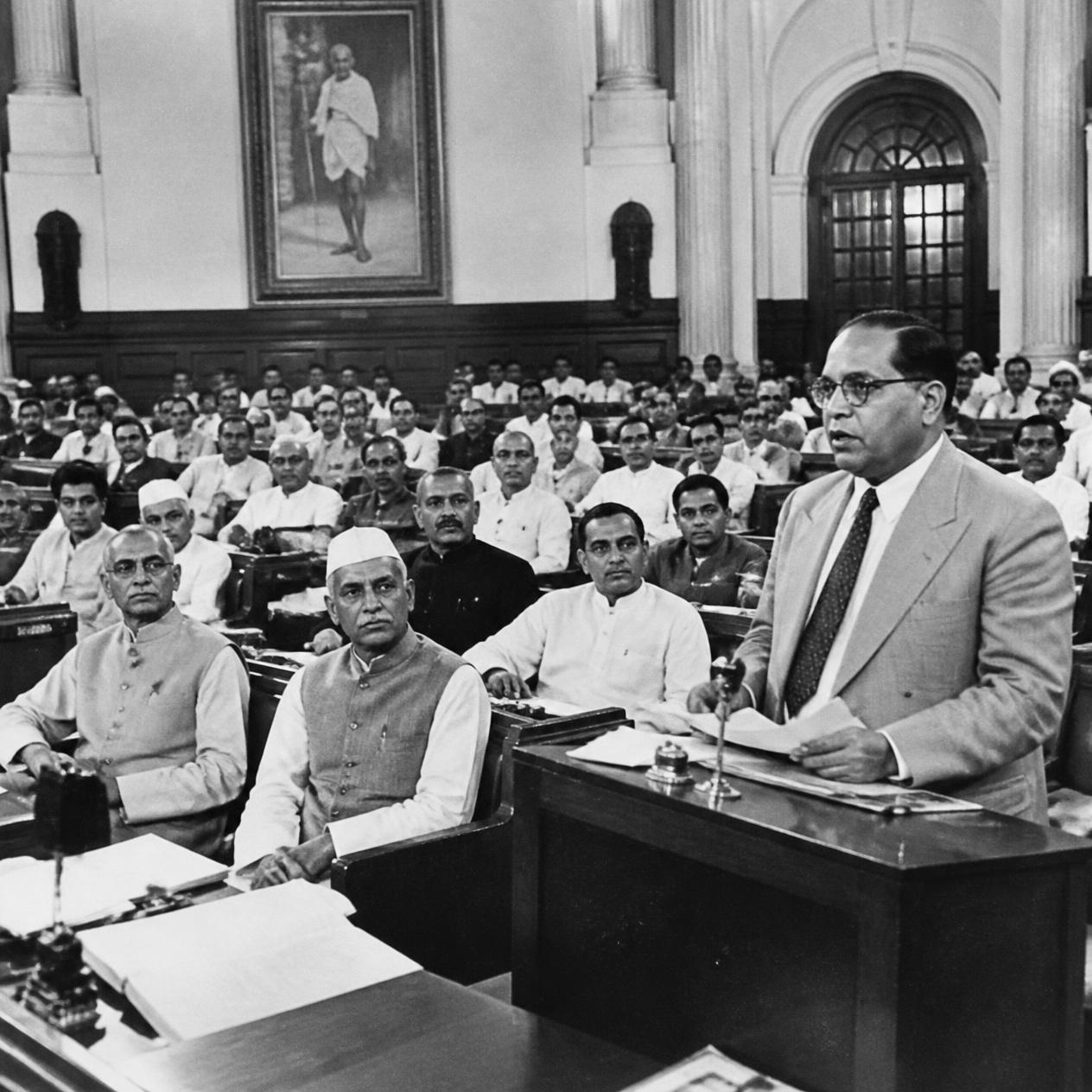
- Dr. B. R. Ambedkar’s Contribution
- Salient Features of the Constitution
- Preamble
- Fundamental Rights
- Fundamental Duties
- Directive Principles of State Policy
- Union and State Governments
- Judiciary
- Constitutional Amendments
- Interesting Facts
- Frequently Asked Questions
- Conclusion
What is the Constitution of India?
The Constitution of India is the supreme legal document that governs the Republic of India. It defines:
- Structure of Government
- Powers of Parliament
- Powers of State Governments
- Powers of Judiciary
- Rights of Citizens
- Duties of Citizens
- Relationship between Union and States
No law in India can override the Constitution. If a law is inconsistent with the Constitution, it may be declared unconstitutional by the courts.
Why is the Constitution Important?
The Constitution serves several important purposes:
- Protects the Fundamental Rights of citizens.
- Establishes democratic governance.
- Prevents misuse of governmental power.
- Ensures equality before the law.
- Promotes justice and liberty.
- Maintains the rule of law.
- Protects the independence of the judiciary.
History of the Constitution
The Constitution was drafted after India gained independence from British rule.
Some important milestones include:
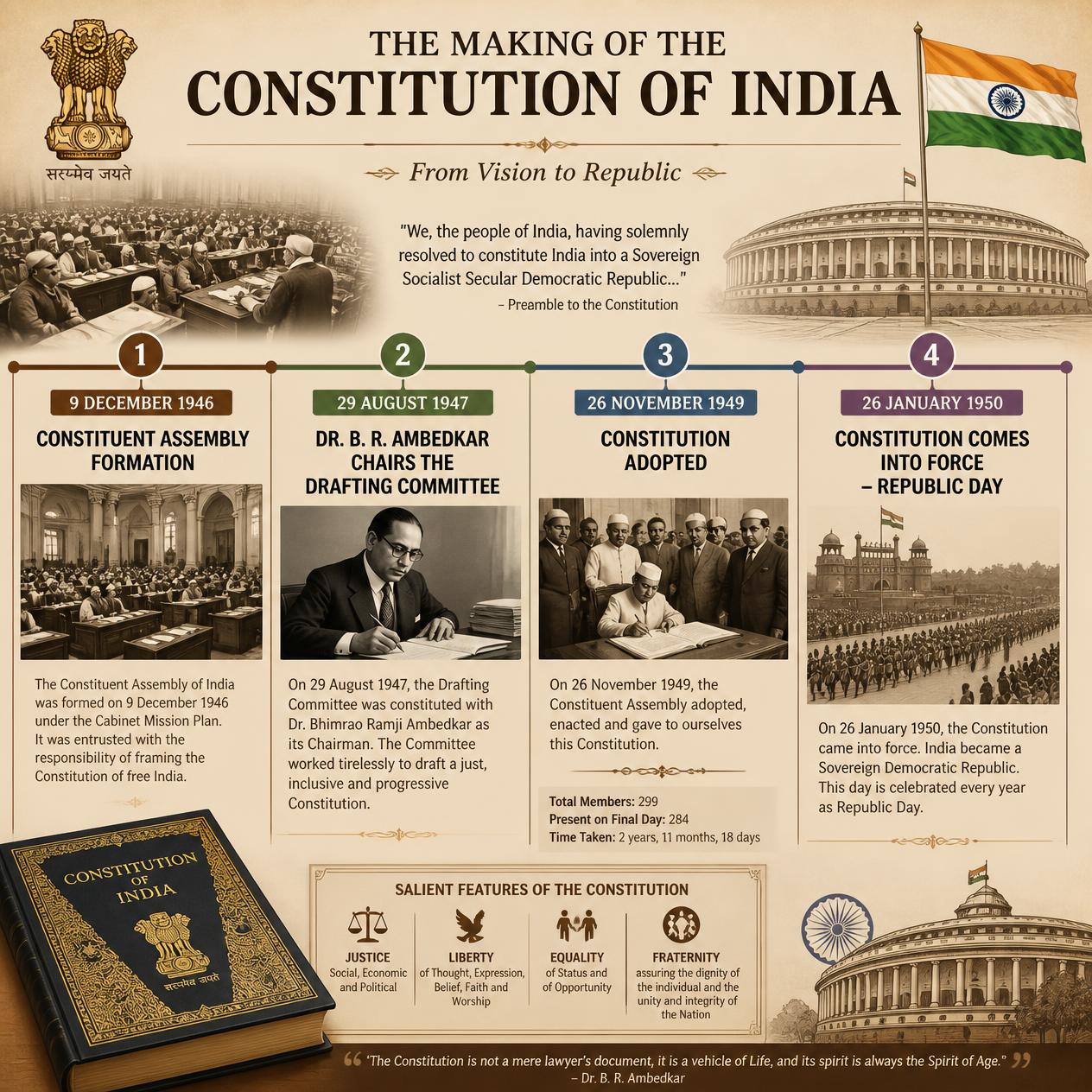
- Constituent Assembly formed in 1946.
- Drafting Committee chaired by Dr. B. R. Ambedkar.
- Constitution adopted on 26 November 1949.
- Constitution came into force on 26 January 1950, celebrated annually as Republic Day.
The Constituent Assembly
The Constituent Assembly was responsible for drafting the Constitution.
Key Facts:
- First meeting: 9 December 1946
- Drafting Committee formed: 29 August 1947
- Chairman of Drafting Committee: Dr. B. R. Ambedkar
- Total time taken: 2 years, 11 months, and 18 days
Salient Features of the Constitution
The Constitution of India has several distinctive features, including:
- Written Constitution
- Parliamentary System
- Federal Structure with a Strong Centre
- Independent Judiciary
- Fundamental Rights
- Directive Principles of State Policy
- Fundamental Duties
- Universal Adult Suffrage
- Secularism
- Rule of Law
The Preamble
The Preamble declares India to be:
- Sovereign
- Socialist
- Secular
- Democratic
- Republic
It also aims to secure:
- Justice
- Liberty
- Equality
- Fraternity
Important Case – Re Berubari Exchange of Enclaves (1960) |
Kesavananda Bharti v. State of kerala (1973)|
Bare Act Language: WE, THE PEOPLE OF INDIA, having solemnly resolved to constitute India into a SOVEREIGN SOCIALIST SECULAR DEMOCRATIC REPUBLIC and to secure to all its citizens:
JUSTICE, social, economic and political;
LIBERTY of thought, expression, belief, faith and worship;
EQUALITY of status and of opportunity;
and to promote among them all
FRATERNITY assuring the dignity of the individual and the unity and integrity of the Nation;
IN OUR CONSTITUENT ASSEMBLY this twenty-sixth day of November, 1949, do HEREBY ADOPT, ENACT AND GIVE TO OURSELVES THIS CONSTITUTION.
Fundamental Rights

Part III of the Constitution guarantees Fundamental Rights.
These include:
- Right to Equality
- Right to Freedom
- Right against Exploitation
- Right to Freedom of Religion
- Cultural and Educational Rights
- Constitutional Remedies
These rights are enforceable by courts.
Part 3 of the constitution which contains fundamental rights has been described as “The Magna Carta” i.e., heart and soul of the Indian constitution. These are certain natural rights which are inherent in every human being by virtue of him being born as a human and are inseparable from him. Granville Austin said that: Corner stone of Indian Democracy”.
Bare Act Language: Right to Equality
- Equality before law.—The State shall not deny to any person equality before the law or the equal protection of the laws within the territory of India.
- Prohibition of discrimination on grounds of religion, race, caste, sex or place of birth.—(1) The State shall not discriminate against any citizen on grounds only of religion, race, caste, sex, place of birth or any of them.
(2) No citizen shall, on grounds only of religion, race, caste, sex, place of birth or any of them, be subject to any disability, liability, restriction or condition with regard to—
(a) access to shops, public restaurants, hotels and places of public entertainment; or
(b) the use of wells, tanks, bathing ghats, roads and places of public resort maintained wholly or partly out of State funds or dedicated to the use of the general public.
(3) Nothing in this article shall prevent the State from making any special provision for women and children.
[(4) Nothing in this article or in clause (2) of article 29 shall prevent the State from making any special provision for the advancement of any socially and educationally backward classes of citizens or for the Scheduled Castes and the Scheduled Tribes.]
[(5) Nothing in this article or in sub-clause (g) of clause (1) of article 19 shall prevent the State from making any special provision, by law, for the advancement of any socially and educationally backward classes of citizens or for the Scheduled Castes or the Scheduled Tribes in so far as such special provisions relate to their admission to educational institutions including private educational institutions, whether aided or unaided by the State, other than the minority educational institutions referred to in clause (1) of article 30.]
[(6) Nothing in this article or sub-clause (g) of clause (1) of article 19 or clause (2) of article 29 shall prevent the State from making,—
(a) any special provision for the advancement of any economically weaker sections of citizens other than the classes mentioned in clauses (4) and (5); and
(b) any special provision for the advancement of any economically weaker sections of citizens other than the classes mentioned in clauses (4) and (5) in so far as such special provisions relate to their admission to educational institutions including private educational institutions, whether aided or unaided by the State, other than the minority educational institutions referred to in clause (1) of article 30, which in the case of reservation would be in addition to the existing reservations and subject to a maximum of ten per cent. of the total seats in each category.
Explanation.—For the purposes of this article and article 16, “economically weaker sections” shall be such as may be notified by the State from time to time on the basis of family income and other indicators of economic disadvantage.]
- Equality of opportunity in matters of public employment.—(1) There shall be equality of opportunity for all citizens in matters relating to employment or appointment to any office under the State.
(2) No citizen shall, on grounds only of religion, race, caste, sex, descent, place of birth, residence or any of them, be ineligible for, or discriminated against in respect of, any employment or office under the State.
(3) Nothing in this article shall prevent Parliament from making any law prescribing, in regard to a class or classes of employment or appointment to an office [under the Government of, or any local or other authority within, a State or Union territory, any requirement as to residence within that State or Union territory] prior to such employment or appointment.
(4) Nothing in this article shall prevent the State from making any provision for the reservation of appointments or posts in favour of any backward class of citizens which, in the opinion of the State, is not adequately represented in the services under the State.
[(4A) Nothing in this article shall prevent the State from making any provision for reservation [in matters of promotion, with consequential seniority, to any class] or classes of posts in the services under the State in favour of the Scheduled Castes and the Scheduled Tribes which, in the opinion of the State, are not adequately represented in the services under the State.]
[(4B) Nothing in this article shall prevent the State from considering any unfilled vacancies of a year which are reserved for being filled up in that year in accordance with any provision for reservation made under clause (4) or clause (4A) as a separate class of vacancies to be filled up in any succeeding year or years and such class of vacancies shall not be considered together with the vacancies of the year in which they are being filled up for determining the ceiling of fifty per cent. reservation on total number of vacancies of that year.]
(5) Nothing in this article shall affect the operation of any law which provides that the incumbent of an office in connection with the affairs of any religious or denominational institution or any member of the governing body thereof shall be a person professing a particular religion or belonging to a particular denomination.
[(6) Nothing in this article shall prevent the State from making any provision for the reservation of appointments or posts in favour of any economically weaker sections of citizens other than the classes mentioned in clause (4), in addition to the existing reservation and subject to a maximum of ten per cent. Of the posts in each category.]
- Abolition of Untouchability.—―Untouchability‖ is abolished and its practice in any form is forbidden. The enforcement of any disability arising out of ―Untouchability shall be an offence punishable in accordance with law.
- Abolition of titles.—(1) No title, not being a military or academic distinction, shall be conferred by the State.
(2) No citizen of India shall accept any title from any foreign State.
(3) No person who is not a citizen of India shall, while he holds any office of profit or trust under the State, accept without the consent of the President any title from any foreign State.
(4) No person holding any office of profit or trust under the State shall, without the consent of the President, accept any present, emolument, or office of any kind from or under any foreign State.
Right to Freedom
- Protection of certain rights regarding freedom of speech, etc.—(1) All citizens shall have the
right—
(a) to freedom of speech and expression;
(b) to assemble peaceably and without arms;
(c) to form associations or unions
[or co-operative societies];
(d) to move freely throughout the territory of India;
(e) to reside and settle in any part of the territory of India;
[and]
(g) to practise any profession, or to carry on any occupation, trade or business.
[(2) Nothing in sub-clause (a) of clause (1) shall affect the operation of any existing law, or prevent the
State from making any law, in so far as such law imposes reasonable restrictions on the exercise of the right
conferred by the said sub-clause in the interests of [the sovereignty and integrity of India,] the security of the State, friendly relations with foreign States, public order, decency or morality, or in relation to contempt of court, defamation or incitement to an offence.]
(3) Nothing in sub-clause (b) of the said clause shall affect the operation of any existing law in so far as it imposes, or prevent the State from making any law imposing, in the interests of [the sovereignty and integrity of India or] public order, reasonable restrictions on the exercise of the right conferred by the said sub-clause.
(4) Nothing in sub-clause (c) of the said clause shall affect the operation of any existing law in so far as it imposes, or prevent the State from making any law imposing, in the interests of the sovereignty and integrity of India or public order or morality, reasonable restrictions on the exercise of the right conferred by the said sub-clause.
(5) Nothing in 1[sub-clauses (d) and (e)] of the said clause shall affect the operation of any existing law in so far as it imposes, or prevent the State from making any law imposing, reasonable restrictions on the exercise of any of the rights conferred by the said sub-clauses either in the interests of the general public or for the protection of the interests of any Scheduled Tribe.
(6) Nothing in sub-clause (g) of the said clause shall affect the operation of any existing law in so far as it imposes, or prevent the State from making any law imposing, in the interests of the general public, reasonable restrictions on the exercise of the right conferred by the said sub-clause, and, in particular, [nothing in the said sub-clause shall affect the operation of any existing law in so far as it relates to, or prevent the State from making any law relating to,—
(i) the professional or technical qualifications necessary for practising any profession or carrying on any occupation, trade or business, or
(ii) the carrying on by the State, or by a corporation owned or controlled by the State, of any trade, business, industry or service, whether to the exclusion, complete or partial, of citizens or otherwise].
- Protection in respect of conviction for offences.—(1) No person shall be convicted of any offence except for violation of a law in force at the time of the commission of the Act charged as an offence, nor be subjected to a penalty greater than that which might have been inflicted under the law in force at the time of the commission of the offence.
(2) No person shall be prosecuted and punished for the same offence more than once.
(3) No person accused of any offence shall be compelled to be a witness against himself.
- Protection of life and personal liberty.—No person shall be deprived of his life or personal liberty except according to procedure established by law.
[21A. Right to education.—The State shall provide free and compulsory education to all children of the age of six to fourteen years in such manner as the State may, by law, determine.]
- Protection against arrest and detention in certain cases.—(1) No person who is arrested shall be detained in custody without being informed, as soon as may be, of the grounds for such arrest nor shall he be denied the right to consult, and to be defended by, a legal practitioner of his choice.
(2) Every person who is arrested and detained in custody shall be produced before the nearest magistrate within a period of twenty-four hours of such arrest excluding the time necessary for the journey from the place of arrest to the court of the magistrate and no such person shall be detained in custody beyond the said period without the authority of a magistrate.
(3) Nothing in clauses (1) and (2) shall apply—
(a) to any person who for the time being is an enemy alien; or
(b) to any person who is arrested or detained under any law providing for preventive detention.
(4) No law providing for preventive detention shall authorise the detention of a person for a longer period than three months unless—
(a) an Advisory Board consisting of persons who are, or have been, or are qualified to be appointed as, Judges of a High Court has reported before the expiration of the said period of three months that there is in its opinion sufficient cause for such detention:
Provided that nothing in this sub-clause shall authorise the detention of any person beyond the maximum period prescribed by any law made by Parliament under sub-clause (b) of clause (7); or
(b) such person is detained in accordance with the provisions of any law made by Parliament under sub-clauses (a) and (b) of clause (7).
(5) When any person is detained in pursuance of an order made under any law providing for preventive detention, the authority making the order shall, as soon as may be, communicate to such person the grounds on which the order has been made and shall afford him the earliest opportunity of making a representation against the order.
(6) Nothing in clause (5) shall require the authority making any such order as is referred to in that clause to disclose facts which such authority considers to be against the public interest to disclose.
(7) Parliament may by law prescribe— [(a) the circumstances under which, and the class or classes of cases in which, a person may be detained for a period longer than three months under any law providing for preventive detention without obtaining the opinion of an Advisory Board in accordance with the provisions of sub-clause (a) of clause(4)]
(b) the maximum period for which any person may in any class or classes of cases be detained under any law providing for preventive detention; and
(c) the procedure to be followed by an Advisory Board in an inquiry under [sub-clause (a) ofclause (4)].
Right against Exploitation
- Prohibition of traffic in human beings and forced labour.—(1) Traffic in human beings and begar and other similar forms of forced labour are prohibited and any contravention of this provision shall be an offence punishable in accordance with law.
(2) Nothing in this article shall prevent the State from imposing compulsory service for public purposes, and in imposing such service the State shall not make any discrimination on grounds only of religion, race, caste or class or any of them.
- Prohibition of employment of children in factories, etc.—No child below the age of fourteen years shall be employed to work in any factory or mine or engaged in any other hazardous employment.
Right to Freedom of Religion
- Freedom of conscience and free profession, practice and propagation of religion.—(1) Subject to public order, morality and health and to the other provisions of this Part, all persons are equally entitled to freedom of conscience and the right freely to profess, practise and propagate religion.
(2) Nothing in this article shall affect the operation of any existing law or prevent the State from making any law—
(a) regulating or restricting any economic, financial, political or other secular activity which may be associated with religious practice;
(b) providing for social welfare and reform or the throwing open of Hindu religious institutions of a public character to all classes and sections of Hindus.
Explanation I.—The wearing and carrying of kirpans shall be deemed to be included in the profession of the Sikh religion.
Explanation II.—In sub-clause (b) of clause (2), the reference to Hindus shall be construed as including a reference to persons professing the Sikh, Jaina or Buddhist religion, and the reference to Hindu religious institutions shall be construed accordingly.
- Freedom to manage religious affairs.—Subject to public order, morality and health, every religious denomination or any section thereof shall have the right—
(a) to establish and maintain institutions for religious and charitable purposes;
(b) to manage its own affairs in matters of religion;
(c) to own and acquire movable and immovable property; and
(d) to administer such property in accordance with law.
- Freedom as to payment of taxes for promotion of any particular religion.—No person shall be compelled to pay any taxes, the proceeds of which are specifically appropriated in payment of expenses for the promotion or maintenance of any particular religion or religious denomination.
- Freedom as to attendance at religious instruction or religious worship in certain educational institutions.—(1) No religious instruction shall be provided in any educational institution wholly maintained out of State funds.
(2) Nothing in clause (1) shall apply to an educational institution which is administered by the State but has been established under any endowment or trust which requires that religious instruction shall be imparted in such institution.
(3) No person attending any educational institution recognised by the State or receiving aid out of State funds shall be required to take part in any religious instruction that may be imparted in such institution or to attend any religious worship that may be conducted in such institution or in any premises attached thereto unless such person or, if such person is a minor, his guardian has given his consent there to Cultural and Educational Rights
- Protection of interests of minorities.—(1) Any section of the citizens residing in the territory of India or any part thereof having a distinct language, script or culture of its own shall have the right to conserve the same.
(2) No citizen shall be denied admission into any educational institution maintained by the State or receiving aid out of State funds on grounds only of religion, race, caste, language or any of them.
- Right of minorities to establish and administer educational institutions.—(1) All minorities, whether based on religion or language, shall have the right to establish and administer educational institutions of their choice.
[(1A) In making any law providing for the compulsory acquisition of any property of an educational institution established and administered by a minority, referred to in clause (1), the State shall ensure that the amount fixed by or determined under such law for the acquisition of such property is such as would not restrict or abrogate the right guaranteed under that clause.]
(2) The State shall not, in granting aid to educational institutions, discriminate against any educational institution on the ground that it is under the management of a minority, whether based on religion or language.
Right to Constitutional Remedies
- Remedies for enforcement of rights conferred by this Part.—(1) The right to move the Supreme Court by appropriate proceedings for the enforcement of the rights conferred by this Part is guaranteed.
(2) The Supreme Court shall have power to issue directions or orders or writs, including writs in the nature of habeas corpus, mandamus, prohibition, quo warranto and certiorari, whichever may be appropriate, for the enforcement of any of the rights conferred by this Part.
(3) Without prejudice to the powers conferred on the Supreme Court by clauses (1) and (2), Parliament may by law empower any other court to exercise within the local limits of its jurisdiction all or any of the powers exercisable by the Supreme Court under clause (2).
(4) The right guaranteed by this article shall not be suspended except as otherwise provided for by this Constitution.
Fundamental Duties
Article 51A outlines the Fundamental Duties of every citizen, including:
- Respect the Constitution.
- Respect the National Flag and National Anthem.
- Protect public property.
- Promote harmony.
- Protect the environment.
- Develop scientific temper.
Bare Act Language: FUNDAMENTAL DUTIES
51A. Fundamental duties.—It shall be the duty of every citizen of India—
(a) to abide by the Constitution and respect its ideals and institutions, the National Flag and the National Anthem;
(b) to cherish and follow the noble ideals which inspired our national struggle for freedom;
(c) to uphold and protect the sovereignty, unity and integrity of India;
(d) to defend the country and render national service when called upon to do so;
(e) to promote harmony and the spirit of common brotherhood amongst all the people of India transcending religious, linguistic and regional or sectional diversities; to renounce practices derogatory to the dignity of women;
(f) to value and preserve the rich heritage of our composite culture;
(g) to protect and improve the natural environment including forests, lakes, rivers and wild life, and to have compassion for living creatures;
(h) to develop the scientific temper, humanism and the spirit of inquiry and reform;
(i) to safeguard public property and to abjure violence;
(j) to strive towards excellence in all spheres of individual and collective activity so that the nation constantly rises to higher levels of endeavour and achievement;
[(k) who is a parent or guardian to provide opportunities for education to his child or, as the case may be, ward between the age of six and fourteen years.]
Directive Principles of State Policy
These principles guide the Government in making laws and policies for social and economic welfare. Although they are not enforceable in courts, they are fundamental to the governance of the country.
Judiciary
The Judiciary safeguards the Constitution and protects citizens’ rights.
The judicial hierarchy includes:
- Supreme Court of India
- High Courts
- District Courts
- Subordinate Courts
Constitutional Amendments
The Constitution is a living document and can be amended under Article 368 to meet changing needs. Amendments must follow the procedure laid down in the Constitution.
Interesting Facts
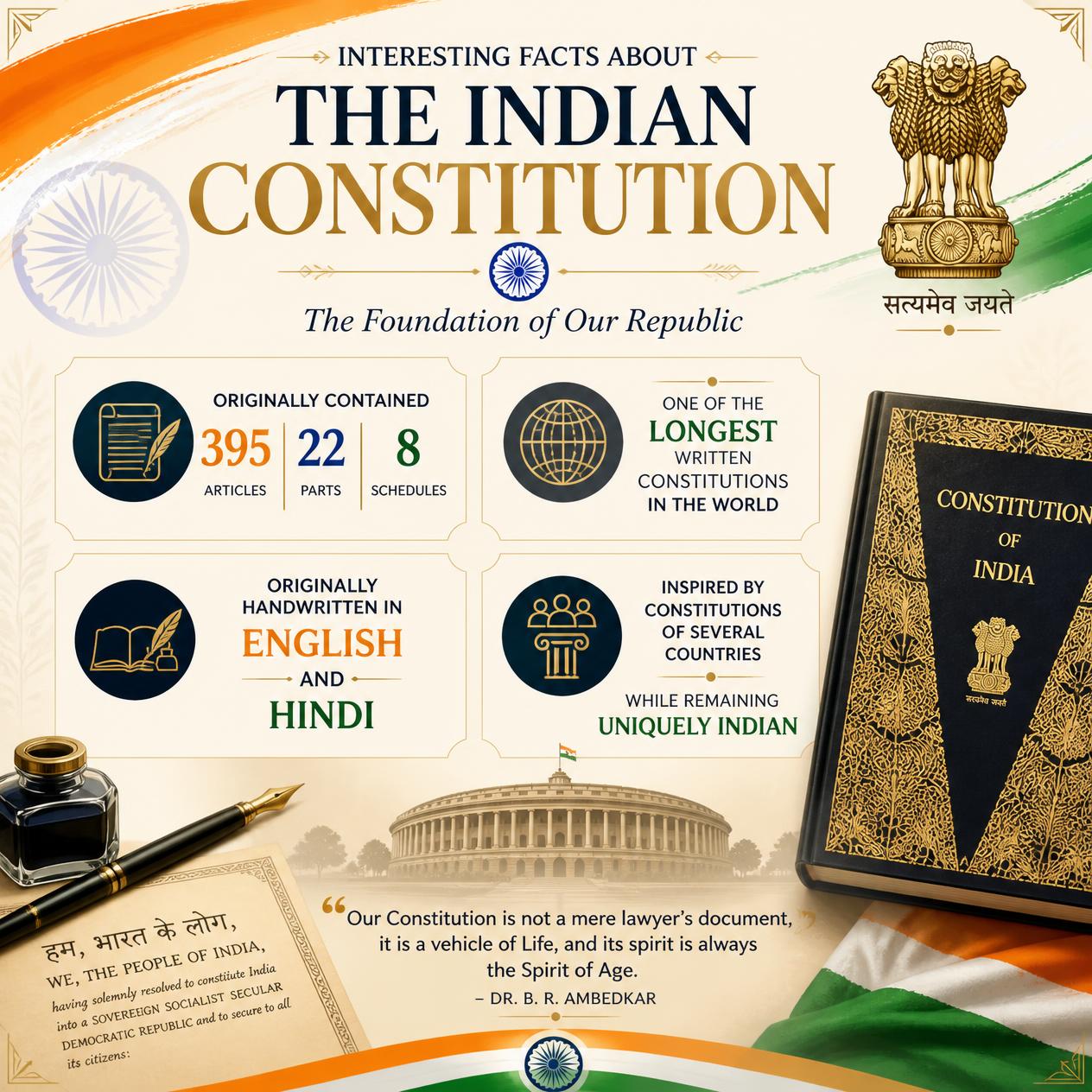
- Originally contained 395 Articles, 22 Parts, and 8 Schedules.
- One of the longest written constitutions in the world.
- Originally handwritten in English and Hindi.
- Inspired by constitutions of several countries while remaining uniquely Indian.
Frequently Asked Questions (FAQs)
Q1. When was the Constitution adopted?
26 November 1949.
Q2. When did it come into force?
26 January 1950.
Q3. Who is known as the Chief Architect of the Constitution?
Dr. B. R. Ambedkar.
Q4. Why is the Constitution called the supreme law?
Because every law in India must conform to it.
Q5. Can the Constitution be amended?
Yes, under Article 368, following the prescribed constitutional procedure.
Conclusion
The Constitution of India is more than a legal document—it is the foundation of our democracy and the protector of our rights and freedoms. Understanding its principles helps citizens become more informed, responsible, and aware of their legal rights and duties.
At Hami Law House, our mission is to make legal knowledge simple, accurate, and accessible. We encourage readers to explore more articles on constitutional law, legal rights, and important judicial developments to deepen their understanding of the Indian legal system.
References
- Constitution of India (Official Text)
- Parliamentary Debates of the Constituent Assembly
- Supreme Court of India
- Ministry of Law and Justice, Government of India